LEGACY PHP / MODERNIZATION

Old code is not automatically disposable code.

Legacy applications often encode years of business decisions. We isolate risk, introduce clearer boundaries and modernize in stages so working behavior survives the process.

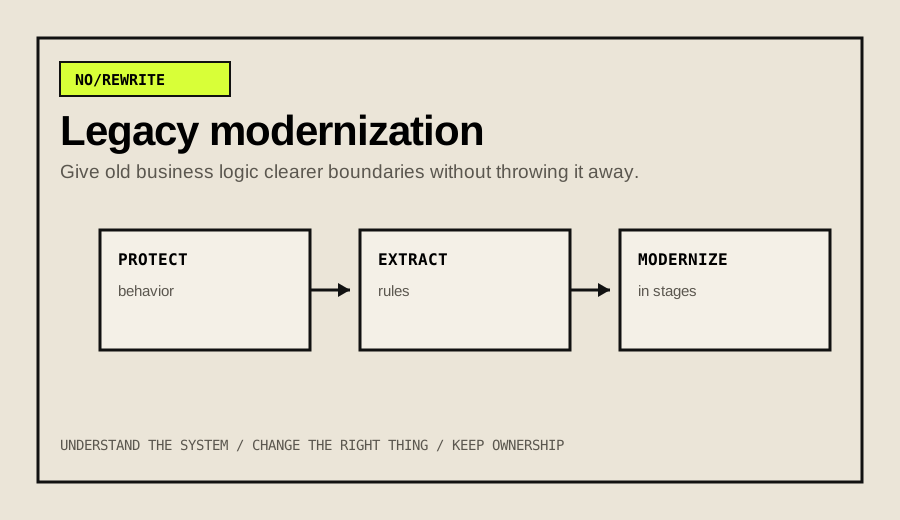
Legacy PHP modernization diagram
PRINCIPLE / PRESERVE BEHAVIOR

Modernization without pretending history has no value.

The dangerous part of legacy code is often not its age. It is the combination of undocumented behavior, shared mutable state, outdated runtime assumptions and important rules living in places nobody expects.

The safest modernization sequence usually creates a boundary around current behavior first, then replaces one risky dependency or responsibility at a time.

Typical modernization work

  • PHP runtime compatibility and deprecation cleanup
  • Dependency isolation and staged replacement
  • Business-rule extraction from controllers, helpers and templates
  • Safer database access and transaction boundaries
  • Characterization tests around existing behavior
  • Incremental framework or component introduction where useful
  • Deployment, configuration and runtime cleanup
RISK MAP / WHAT USUALLY BLOCKS CHANGE

Legacy risk is normally concentrated, not evenly distributed.

The goal is to find the parts that make ordinary change dangerous and create boundaries around those first, rather than treating every old file as equally urgent.

01 / RUNTIME

Version and extension assumptions.

Unsupported PHP versions, removed language behavior, old extensions and dependency constraints can make even a small upgrade unpredictable.

02 / GLOBAL STATE

Configuration hidden everywhere.

Globals, static state, includes and environment assumptions make behavior depend on call order or server setup instead of explicit inputs.

03 / DATA ACCESS

SQL and business rules fused together.

Large queries, database views and controller-side calculations often share responsibility in ways that are difficult to test or replace safely.

04 / SIDE EFFECTS

One action changes too many things.

Email, billing, inventory, file writes and external API calls can be triggered from the same path without a clear transaction or recovery boundary.

05 / DEPENDENCIES

Libraries nobody can upgrade.

Old packages and bespoke integrations can pin the runtime or framework until their actual usage and replacement risk are understood.

06 / KNOWLEDGE

Rules live in memory, not documentation.

The system may be technically functional while operational knowledge exists only in one person, one deployment script or one undocumented convention.

OUTPUT / MODERNIZATION PLAN

A useful modernization plan says what can stay.

Not every legacy component deserves immediate replacement. The output should separate stable business behavior from the parts that create operational risk, upgrade blockers or excessive change cost.

  • Current runtime and dependency constraints
  • High-risk coupling and business-rule locations
  • Characterization points for behavior that must survive
  • Recommended extraction or replacement sequence
  • Deployment and rollback considerations for each stage
  • Deferred work that is safe to leave alone for now
SEQUENCE / STRANGLER, NOT BIG BANG

Make the change surface smaller before making the change bigger.

A staged modernization creates places where new code can live without requiring the whole application to move at once.

EXAMPLE / BUSINESS-RULE EXTRACTION

Keep the screen. Change where the decision lives.

One selected engineering example shows rules moving out of controllers, database views and helper fragments into a single application-level home while preserving the existing caller contract.

Read the engineering example