Understand the real system.
Repositories, databases, scheduled jobs, integrations, deployment paths, runtime dependencies and business rules.
NoRewrite learns the existing application, maps business-critical behavior, stabilizes the risky parts and establishes clear technical ownership.
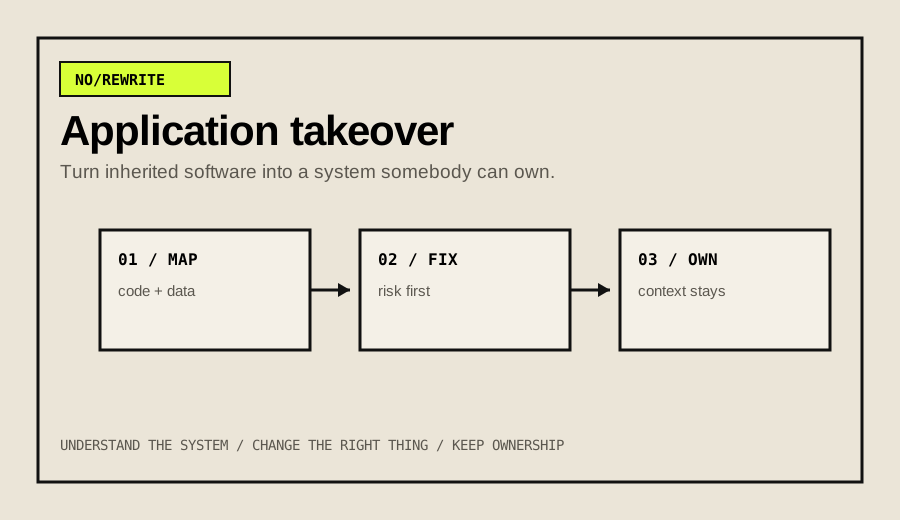
The fastest way to make an inherited system more dangerous is to start “cleaning it up” before understanding what depends on it.
Repositories, databases, scheduled jobs, integrations, deployment paths, runtime dependencies and business rules.
Identify the failures, risks and bottlenecks that deserve attention first instead of refactoring everything at once.
Document material decisions, reduce risky coupling and preserve technical context across future work.
The exact documents depend on scope, but the takeover should leave explicit technical context that can survive another handover.
Runtime, repositories, services, data stores, workers, schedules and external dependencies.
Concrete production, security, data-integrity, maintenance and continuity risks ranked by impact and urgency.
How code reaches production, what must happen before release, and how rollback/recovery works.
What should be stabilized immediately, what can be modernized later, and what should intentionally remain unchanged.
Takeover work often requires access to systems that already matter commercially. The default is to start with the least access needed, understand the recovery path, and increase privileges only when the work requires it.
Repository, database and production access can begin read-only where practical. Write access is requested only for agreed work.
Passwords, private keys and API credentials belong in an agreed secure channel, never in the website enquiry form or ordinary notes.
Material production changes are made with the deployment path, backup state and rollback option understood before release.
Client repositories, application data and credentials remain client assets. Access can be removed at the end of the engagement.
Confidentiality terms can be agreed before repository or production access when your organization requires them.
Material findings, changes and technical decisions are documented so the next person does not have to reconstruct the same context.
One selected engineering example shows the runtime, data, integration and delivery artifacts used to turn undocumented operational knowledge into an explicit ownership model.
Prefer email instead of live chat?
If you want a reply after closing the chat, leave an email address below.