LARAVEL TAKEOVER / EXISTING APPLICATIONS

Specialist Laravel takeover for software that already runs the business.

Framework familiarity matters. So does knowing where mature Laravel applications usually hide cost and risk: model relationships, authorization, queues, scheduled tasks, packages, data access and deployment assumptions.

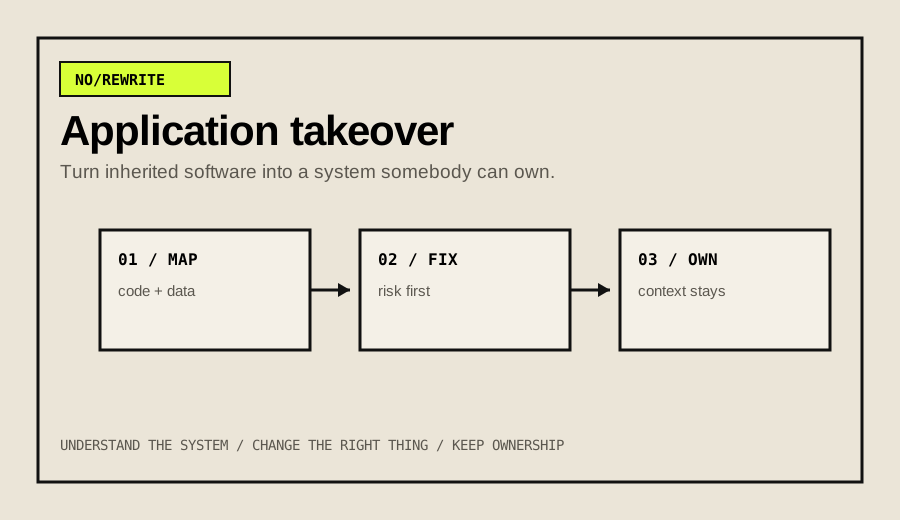
Laravel takeover illustration
WHY / FRAMEWORK KNOWLEDGE IS NOT ENOUGH

Laravel helps structure new code. It does not explain years of inherited decisions.

A mature Laravel codebase can be conventionally structured and still carry operational risk through model events, hidden scopes, queue behavior, package assumptions, database views, duplicated business logic or deployment steps that only one person remembers.

The takeover starts by locating those application-specific contracts before trying to make the code “cleaner.”

Laravel-specific takeover work can include

  • Framework version, PHP version and dependency compatibility
  • Eloquent relationships, scopes, observers and model events
  • N+1 queries, broad hydration and expensive aggregate paths
  • Jobs, queues, failed jobs, workers and scheduler behavior
  • Policies, guards, middleware and authorization boundaries
  • Service container bindings and application-level abstractions
  • Storage, mail, cache and external service configuration
  • Laravel upgrade planning and staged execution
FIRST PASS / WHAT GETS MAPPED

Look beyond controllers and routes.

A useful Laravel review follows behavior across framework boundaries instead of judging files in isolation.

Request path

Routes, middleware, authorization, controllers, services, model scopes and response contracts.

Background path

Dispatch points, queue connection, workers, retry policy, failed jobs, scheduled commands and idempotency concerns.

Data path

Eloquent relationships, raw queries, views, aggregates, caching and the expensive paths users actually wait for.

Runtime path

Environment, storage, cache, sessions, cron, queue processes, deployment commands and application-specific production assumptions.

OUTPUT / WHAT CHANGES

A safer application, not just a longer issue list.

Typical next work is prioritized around business risk: stabilize failure modes, remove expensive bottlenecks, document hidden dependencies, then modernize the framework or structure where it creates real leverage.